Understand the advance.
Put the idea in motion.
Seven interactive experiments, grounded in recent research. Every example has a question you can test.
Pressure is only half the story.
Separate force into compression and sliding. A spatial sensor map makes their differences visible.
Inspect a low-pressure patch that still has high shear.
Compare the two channels, then disconnect a sensor to distinguish missing data from zero.
See the hidden shear
24 / 24 cells available · synthetic percentage signals
Compression and sliding are independent channels.
The grid uses synthetic signals on a flat schematic. It is not an anatomical pressure map or a skin-damage assessment.
Inspect the demonstration rules
The synthetic field uses a fixed Gaussian spatial pattern. Cell brightness follows normal signal; arrow length follows shear; the angle follows sliding direction. A disconnected cell emits no value.
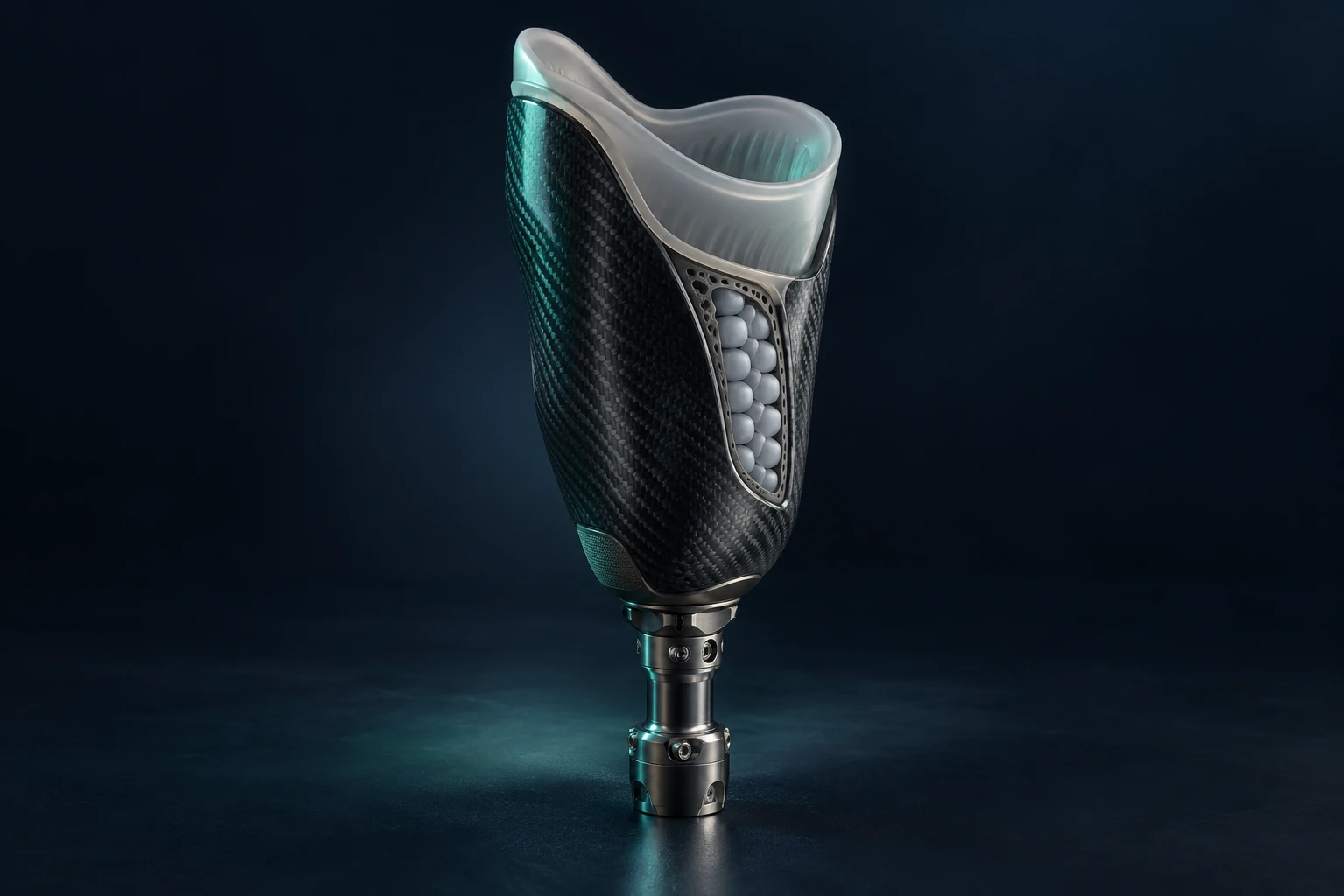
A Science Advances study reports embroidered sensors that map normal and shear forces, including a prosthetic-socket demonstration with one below-knee participant.
Demo settings remain in this view during the session. Export an experiment to retain its parameters. These experiments do not change your care case or control a device.